
About Us & Goju Ryu

About United Martial Artist Academy
The United Martial Artist Academy has a rich history, evolving since its establishment in 1972. Initially, under different ownership, it was among the first martial arts schools in Monmouth County, welcoming students of all ages. The academy initially offered a diverse range of martial arts, including Aikido, Judo, Jujitsu, and Kobudo weapons training. Its foundational style was Kardojitsu Ryu, a pioneering American Mixed Martial Arts form.
Over time, the school transitioned towards a more Americanized version of Goju-Ryu, a traditional Okinawan karate style known for its “hard-soft” approach, blending powerful strikes with softer, flowing techniques.
Recently, the academy has embraced its traditional roots once again, now primarily focusing on Okinawan Karate with a specific emphasis on Okinawan Goju Ryu Kenkyukai, a curriculum that honors the rich heritage and depth of this martial art.

About Goju Ryu
United Martial Artist Academy is proud to be a part of the prestigious Okinawa Goju Ryu Kenkyukai, a distinguished organization dedicated to preserving and promoting the traditional Okinawan style of Goju-Ryu karate. This affiliation connects our school to a lineage of martial arts excellence, emphasizing not just physical prowess but also the rich cultural heritage of Okinawan karate. Our membership in the Kenkyukai underscores our commitment to delivering authentic martial arts training, focusing on both the technical aspects of kata and kihon and delving deeper into the underlying principles and philosophies of Goju-Ryu.
Goju-Ryu, meaning “hard-soft style,” is a blend of both hard and soft techniques, a duality that reflects the essence of the martial arts book “Bubishi,” revered by Okinawan masters. This style was developed through the dedicated efforts of pioneers like Higaonna Kanryo, who integrated the hard (gō-no) and soft (jū-no) kenpō into a coherent system, and later, Chojun Miyagi, who formalized Goju-Ryu. The name Goju-Ryu was conceptualized by Miyagi’s student, Jin’an Shinzato, and later adopted by Miyagi, inspired by the principles of the Bubishi. It emphasizes correct breathing in kata, particularly in the core Sanchin and Tensho kata, and encompasses a comprehensive approach including body conditioning, fighting strategies, and partner drills. By training in Goju-Ryu, practitioners at United Martial Artist Academy engage in a holistic martial arts experience, cultivating physical strength, mental discipline, and a deep understanding of Goju-Ryu’s balanced and profound philosophy
About Traditional Okinawan Goju Ryu Katas
Traditional Goju-Ryu katas are a series of choreographed martial arts movements practiced in Goju-Ryu, an Okinawan style of karate. These katas serve as a way to practice and preserve the techniques and principles of the style. They are composed of a sequence of defensive and offensive movements, embodying the “hard-soft” philosophy of Goju-Ryu. This means they include both powerful, direct strikes and blocks (hard techniques) as well as more fluid, circular movements (soft techniques). Practicing these katas helps students develop physical skills, mental discipline, and a deeper understanding of the martial art’s strategies and philosophies.
Chojun Miyagi, the founder of Goju-Ryu karate, famously stated, “It should be known that the secret principles of Goju-Ryu exist within the kata.” Kata are choreographed sequences of martial arts techniques and movements, embodying the core of karate practice. Taira Masaji, a 9th dan Chairman and Hanshi (a senior expert title) of the Okinawa Goju Ryu Kenkyukai, focuses on training the application of these kata techniques for self-defense, known as bunkai. Bunkai involves interpreting and practicing the fighting applications of kata movements. The Okinawa Goju Ryu Kenkyukai emphasizes understanding the full spectrum of fighting applications (bunkai) from the beginning to the end of each kata, highlighting the dynamic and adaptable nature of these traditional forms.
Okinawan Goju Ryu Katas
Sanchin – “Three Battles/Conflicts/Challenges”
Sanchin, one of Goju-Ryu’s two “heishu” (closed-hand) katas, is often misunderstood in Karate. Despite this, it’s a crucial training exercise in Goju-Ryu, featuring in various Chinese martial arts, such as Crane, Dragon, Tiger, Lion, and Monk Fist Boxing. Sanchin combines internal elements like deep breathing with external techniques, including alignment and strength. However, due to limited understanding of its Chinese origins, it’s frequently reduced to an isometric form with excessive tension and incorrect breathing. The name Sanchin, meaning “Three Battles,” symbolizes the physical, mental, and spiritual challenges it presents, aligning with the Chinese concepts of Shen (spirit), Shin (mind), and Li (body), or could refer to TCM’s “Three Burners.”
Gekisai Dai Ichi / Gekisai Dai Ni – “Attack & Destroy”
The Gekisai Kata were formulated by Chojun Miyagi Sensei in 1940 as a form of physical exercise for high school boys and to help popularize Goju-Ryu among the public of Okinawa. In 1948, after WWII, Miyagi Sensei began to teach the Gekisai Kata in depth as a regular part of Goju-Ryu in his own dojo. Until this time, Sanchin was the first Kata taught in Goju-Ryu. Sanchin is physically and mentally a demanding Kata and requires a great deal of time and patience to learn and perform properly. The Gekisai Kata however are easier to learn and perform, and contain dynamic techniques which are more attractive to young people. These Kata contain the same kanji for “sai” found in Saifa. This would suggest that even though these Kata were designed primarily as a form of exercise, Miyagi Sensei included his understanding of combat as part of their makeup.ody), or could refer to TCM’s “Three Burners.”
Saifa – “Rip and Tear Apart”
Saifa is the first of the classical combative Kata taught in Goju-Ryu. Goju-Ryu’s Kata origins come from the martial arts taught in the Fuzhou area of southern China, largely Crane and Xingyi/Baqua as well as other internal and external martial arts. Kanryo Higaonna Sensei was taught this Kata, along with the other Kata of Goju-Ryu, while he studied in China from 1863-1881 under the direction of RuRuKo (Xie Zhongxiang in Chinese) and others. These Kata and martial strategies would become the basis of the the quanfa of Higaonna Sensei, which later Miyagi Sensei would call Goju-Ryu. From an understanding of the grappling and striking techniques of this Kata, Saifa can be interpreted to mean grabbing and tearing of tissue in close-quartered combat.
Seiyunchin – “Control/Suppress and Pull”
The name Seiyunchin implies the use of techniques to off balance, throw and grapple. It is this understanding that imparts the original intentions of the Kata of Naha-te before the sport alignment of modern Karate. Seiyunchin contains close-quartered striking, sweeps, take-downs and throws. Though the Kata itself is void of kicks, many practitioners make the grave mistake by missing the opportunity to apply any leg technique. Though almost invisible to the untrained eye, the subtleness of “ashi barai” and “suri ashi” can represent foot sweeps, parries and traps.
Shisochin – “Four Directions/Gates of Conflict/Attack”
Shisochin translates as “Four Gates” or “Four Directions of Conflict”. To leave it at that discounts a truer understanding. The third kanji is the same found in Sanchin and Seiyunchin, which translates as “battle” or “conflict”. This lends to a deeper definition of its meaning. The idea of four directions can come from the performance of the four shotei in four directions. It can also represent the four elements represented in Chinese medicine (Acupuncture is one) of Wood, Fire, Metal and Water with man representing Earth. Since this was the science and culture of that period in China when Higaonna and Miyagi both studied in Fuzhou, it would be a great oversight to discount this aspect as a very probable explanation of the Kata’s name and martial intent.
Sanseru – “36 Hands”
Sanseru is unique as Miyagi Sensei studied this Kata under a direct student of RuRuKo during his studies in Fuzhou, China beginning in 1916. An explanation of the name Sanseru and the other numerically named Kata is that they refer to a systematic method and understanding of certain groupings of vital acupressure points. It is this science that the martial arts was based upon and developed. Feng Yiquan, who lived during the Ming Dynasty (1522-67) developed this particular method of using variations of “36” forbidden points to defeat his opponents. Other disciples of Feng created other quans expanding the number to 72 and ultimately 108. Sanseru is found in the following styles of Chinese Boxing: Crane, Tiger, and Dog.
Sepai – “18 Hands”
The reference to “18” in naming this Kata has a couple of interpretations. Like Sanseru, the most apparent and most meaningful in the naming of Sepai is again from the martial arts development and the use of attacking pressure points. 18 is one half of 36 suggesting that perhaps an alternative set of attacks and defenses of preferred techniques and strategies from the original Sanseru 36. Sepai is found in Monk Boxing.
Kururunfa – “Holding Ground”
Kururunfa epitomizes the ideals of Go-“hard and Ju-“soft”. Stance transitions are quick and explosive while the hands techniques are employed using “muchimi” or a heavy, sticky movement. As in the other kata of Goju-Ryu, it is quite evident that grappling and close-quartered fighting is the favored fighting style. The same kanji “fa”is found in Saifa. Again, this would suggest a strong emphasis on grappling. Where most other styles’ Kata concentrate on “block/punch”, it is obvious from the unique techniques that this is not the case with Goju-Ryu.
Sesan – “13 Hands”
Sesan, Sanseru and Sepai all share the kanji “se”. This may well be a Chinese dialect of the Okinawan term “te” or “fighting hand”, referring to life-protection techniques. To better understand these Kata requires a more defined understanding of the language and culture of the people from which these Kata originated.
Sesan is believed to be the oldest of all Okinawan Goju-Ryu Kata. There is a version of Sesan practiced in the Shorin schools, but in comparison, the Goju-Ryu version is longer and much more complex. Sesan is practiced in the following styles of Chinese Boxing: Dragon, Lion and Monk Fist.
Suparinpei – “108 Hands”
Suparinpei, the most advanced Kata in Goju-Ryu, has the highest number of techniques and variations. Although seemingly simple, its complexity emerges through transitions and tempo changes, making it technically second only to Sanchin. The number “108” in Suparinpei, possibly influenced by Buddhism, symbolizes the “108 sins of man,” reflected in the tradition of ringing temple bells 108 times at the Chinese New Year to dispel evil.
Post-Boxing Rebellion and Qing Dynasty’s fall, the focus on such intricate martial arts dwindled, with many practicing them for exercise, recreation, or performance. The increasing use of firearms also diminished the relevance of hand-to-hand combat. Suparinpei is integral to Dragon, Tiger, and Monk Fist styles of Chinese Boxing.
Tensho – “Turning Palms”
Tensho, the second “heishu” (closed-hand) kata in Goju-Ryu, is an Okinawan adaptation of the Chinese “Rokkishu.” While Sanchin closely resembles its Chinese counterpart, Tensho reflects Miyagi Sensei’s insights into Goju-Ryu’s techniques and human nature. Tensho builds on Sanchin’s principles, introducing more complex Goju-Ryu techniques, particularly evident in advanced kakie training. Unlike the hard, external breathing in Sanchin, Tensho’s breathing is softer and internal, often mistaken as similar to Sanchin by the untrained eye.
“Heishu” signifies muscle contraction and specific breathing, as seen in Sanchin and Tensho, and also implies controlled energy flow in the body. Contrarily, the other ten “kaishu” (open-hand) katas feature more relaxed muscle states and normal breathing patterns.


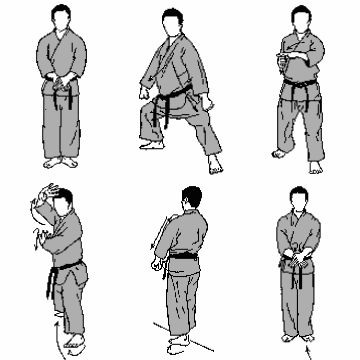
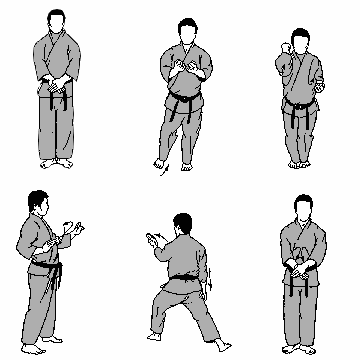
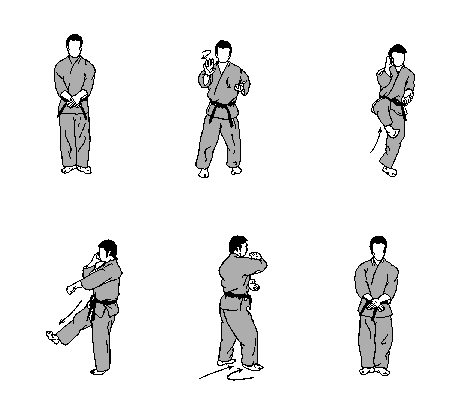
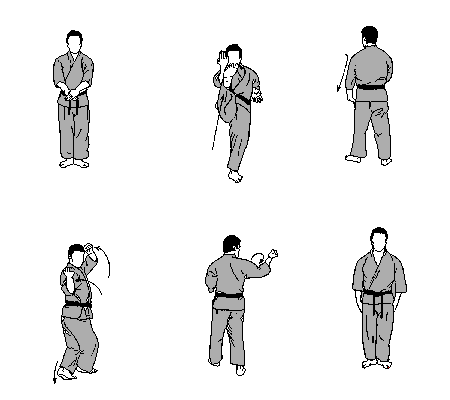
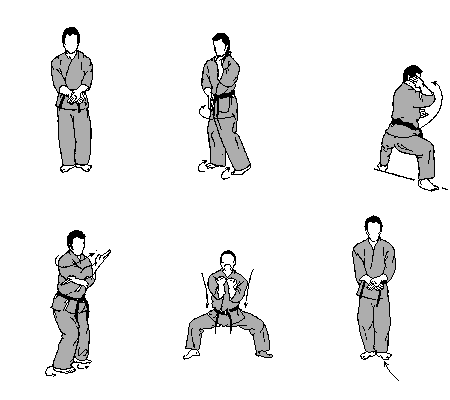
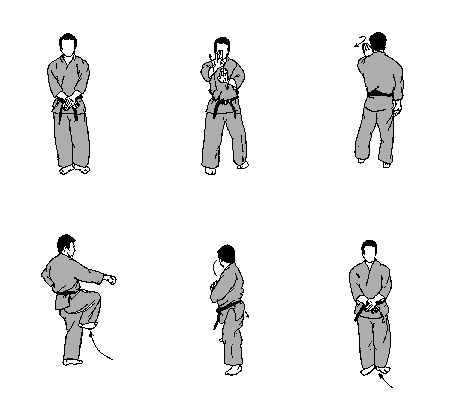
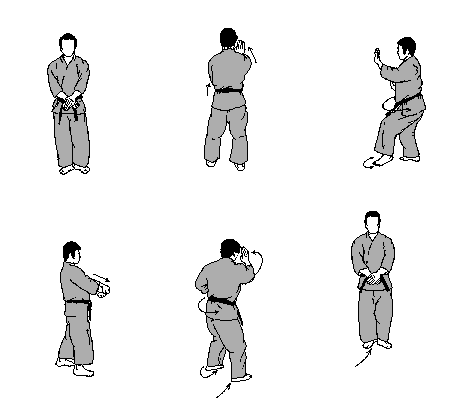
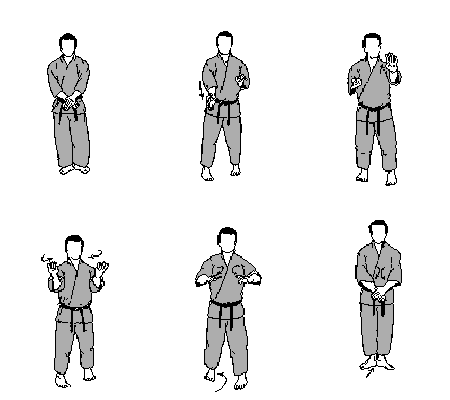
Sanchin – “Three Battles/Conflicts/Challenges”
Sanchin, one of Goju-Ryu’s two “heishu” (closed-hand) katas, is often misunderstood in Karate. Despite this, it’s a crucial training exercise in Goju-Ryu, featuring in various Chinese martial arts, such as Crane, Dragon, Tiger, Lion, and Monk Fist Boxing. Sanchin combines internal elements like deep breathing with external techniques, including alignment and strength. However, due to limited understanding of its Chinese origins, it’s frequently reduced to an isometric form with excessive tension and incorrect breathing. The name Sanchin, meaning “Three Battles,” symbolizes the physical, mental, and spiritual challenges it presents, aligning with the Chinese concepts of Shen (spirit), Shin (mind), and Li (body), or could refer to TCM’s “Three Burners.”
Gekisai Dai Ichi / Gekisai Dai Ni – “Attack & Destroy”
The Gekisai Kata were formulated by Chojun Miyagi Sensei in 1940 as a form of physical exercise for high school boys and to help popularize Goju-Ryu among the public of Okinawa. In 1948, after WWII, Miyagi Sensei began to teach the Gekisai Kata in depth as a regular part of Goju-Ryu in his own dojo. Until this time, Sanchin was the first Kata taught in Goju-Ryu. Sanchin is physically and mentally a demanding Kata and requires a great deal of time and patience to learn and perform properly. The Gekisai Kata however are easier to learn and perform, and contain dynamic techniques which are more attractive to young people. These Kata contain the same kanji for “sai” found in Saifa. This would suggest that even though these Kata were designed primarily as a form of exercise, Miyagi Sensei included his understanding of combat as part of their makeup.ody), or could refer to TCM’s “Three Burners.”
Saifa – “Rip and Tear Apart”
Saifa is the first of the classical combative Kata taught in Goju-Ryu. Goju-Ryu’s Kata origins come from the martial arts taught in the Fuzhou area of southern China, largely Crane and Xingyi/Baqua as well as other internal and external martial arts. Kanryo Higaonna Sensei was taught this Kata, along with the other Kata of Goju-Ryu, while he studied in China from 1863-1881 under the direction of RuRuKo (Xie Zhongxiang in Chinese) and others. These Kata and martial strategies would become the basis of the the quanfa of Higaonna Sensei, which later Miyagi Sensei would call Goju-Ryu. From an understanding of the grappling and striking techniques of this Kata, Saifa can be interpreted to mean grabbing and tearing of tissue in close-quartered combat.
Seiyunchin – “Control/Suppress and Pull”
The name Seiyunchin implies the use of techniques to off balance, throw and grapple. It is this understanding that imparts the original intentions of the Kata of Naha-te before the sport alignment of modern Karate. Seiyunchin contains close-quartered striking, sweeps, take-downs and throws. Though the Kata itself is void of kicks, many practitioners make the grave mistake by missing the opportunity to apply any leg technique. Though almost invisible to the untrained eye, the subtleness of “ashi barai” and “suri ashi” can represent foot sweeps, parries and traps.
Shisochin – “Four Directions/Gates of Conflict/Attack”
Shisochin translates as “Four Gates” or “Four Directions of Conflict”. To leave it at that discounts a truer understanding. The third kanji is the same found in Sanchin and Seiyunchin, which translates as “battle” or “conflict”. This lends to a deeper definition of its meaning. The idea of four directions can come from the performance of the four shotei in four directions. It can also represent the four elements represented in Chinese medicine (Acupuncture is one) of Wood, Fire, Metal and Water with man representing Earth. Since this was the science and culture of that period in China when Higaonna and Miyagi both studied in Fuzhou, it would be a great oversight to discount this aspect as a very probable explanation of the Kata’s name and martial intent.
Sanseru – “36 Hands”
Sanseru is unique as Miyagi Sensei studied this Kata under a direct student of RuRuKo during his studies in Fuzhou, China beginning in 1916. An explanation of the name Sanseru and the other numerically named Kata is that they refer to a systematic method and understanding of certain groupings of vital acupressure points. It is this science that the martial arts was based upon and developed. Feng Yiquan, who lived during the Ming Dynasty (1522-67) developed this particular method of using variations of “36” forbidden points to defeat his opponents. Other disciples of Feng created other quans expanding the number to 72 and ultimately 108. Sanseru is found in the following styles of Chinese Boxing: Crane, Tiger, and Dog.
Sepai – “18 Hands”
The reference to “18” in naming this Kata has a couple of interpretations. Like Sanseru, the most apparent and most meaningful in the naming of Sepai is again from the martial arts development and the use of attacking pressure points. 18 is one half of 36 suggesting that perhaps an alternative set of attacks and defenses of preferred techniques and strategies from the original Sanseru 36. Sepai is found in Monk Boxing.
Kururunfa – “Holding Ground”
Kururunfa epitomizes the ideals of Go-“hard and Ju-“soft”. Stance transitions are quick and explosive while the hands techniques are employed using “muchimi” or a heavy, sticky movement. As in the other kata of Goju-Ryu, it is quite evident that grappling and close-quartered fighting is the favored fighting style. The same kanji “fa”is found in Saifa. Again, this would suggest a strong emphasis on grappling. Where most other styles’ Kata concentrate on “block/punch”, it is obvious from the unique techniques that this is not the case with Goju-Ryu.
Sesan – “13 Hands”
Sesan, Sanseru and Sepai all share the kanji “se”. This may well be a Chinese dialect of the Okinawan term “te” or “fighting hand”, referring to life-protection techniques. To better understand these Kata requires a more defined understanding of the language and culture of the people from which these Kata originated.
Sesan is believed to be the oldest of all Okinawan Goju-Ryu Kata. There is a version of Sesan practiced in the Shorin schools, but in comparison, the Goju-Ryu version is longer and much more complex. Sesan is practiced in the following styles of Chinese Boxing: Dragon, Lion and Monk Fist.
Suparinpei – “108 Hands”
Suparinpei, the most advanced Kata in Goju-Ryu, has the highest number of techniques and variations. Although seemingly simple, its complexity emerges through transitions and tempo changes, making it technically second only to Sanchin. The number “108” in Suparinpei, possibly influenced by Buddhism, symbolizes the “108 sins of man,” reflected in the tradition of ringing temple bells 108 times at the Chinese New Year to dispel evil.
Post-Boxing Rebellion and Qing Dynasty’s fall, the focus on such intricate martial arts dwindled, with many practicing them for exercise, recreation, or performance. The increasing use of firearms also diminished the relevance of hand-to-hand combat. Suparinpei is integral to Dragon, Tiger, and Monk Fist styles of Chinese Boxing.
Tensho – “Turning Palms”
Tensho, the second “heishu” (closed-hand) kata in Goju-Ryu, is an Okinawan adaptation of the Chinese “Rokkishu.” While Sanchin closely resembles its Chinese counterpart, Tensho reflects Miyagi Sensei’s insights into Goju-Ryu’s techniques and human nature. Tensho builds on Sanchin’s principles, introducing more complex Goju-Ryu techniques, particularly evident in advanced kakie training. Unlike the hard, external breathing in Sanchin, Tensho’s breathing is softer and internal, often mistaken as similar to Sanchin by the untrained eye.
“Heishu” signifies muscle contraction and specific breathing, as seen in Sanchin and Tensho, and also implies controlled energy flow in the body. Contrarily, the other ten “kaishu” (open-hand) katas feature more relaxed muscle states and normal breathing patterns.